Camino de Santiago

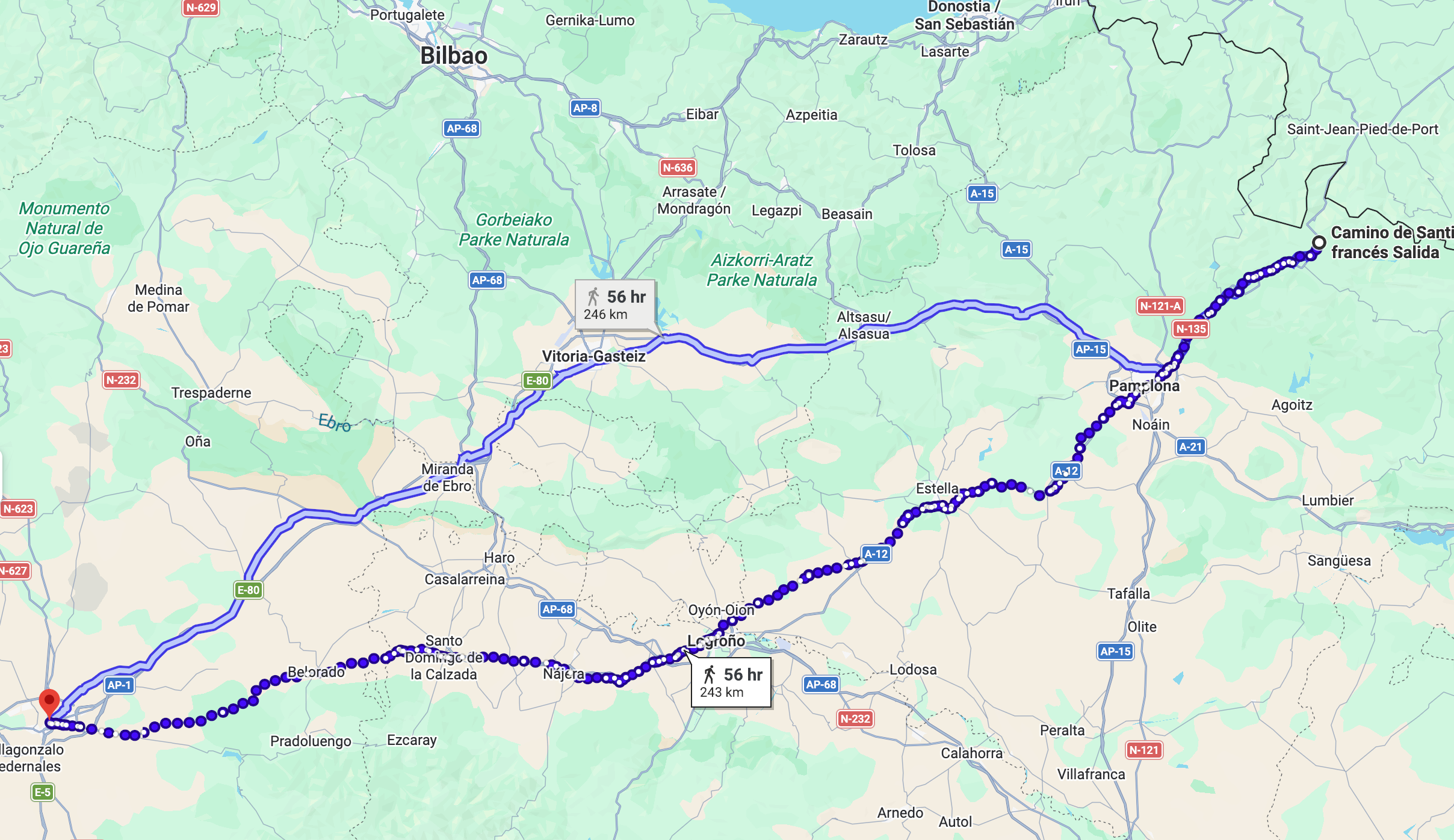
10-Day Camino Francés — Full Detail Version
September/October - Experiential Focus
The Setup
The goal is to cherry-pick the best 4 sections of the Camino for the shared 10 days, keep it experiential and upscale, then give you options for what to do after the Dublin pair flies home.
https://www.mycaminobed.com/caminos/camino-de-santiago
Flights & Arrival Logistics
Arrival: Fly into Bilbao or Madrid and connect. Madrid → Bilbao is a short flight or a 5-hr AVE train if you want to see more.
From Bilbao to Roncesvalles: ~2.5 hrs by private transfer (€120-150 for the car) or public bus via Pamplona. Private transfer is worth it on arrival day — you're not fighting luggage on Spanish buses after a travel day.
Return: Burgos → Dublin for the Irish couple Burgos → Madrid by AVE (2.5 hrs, excellent trains, €30-60 per person). Madrid Barajas → Dublin direct. Book the AVE in advance on Renfe — seats fill up on September weekends.
Bag Transfer on the Camino — How It Works
The basic model is the same across all providers: you leave your luggage at hotel reception before 8am with a label attached, and it arrives at your next hotel by 2:30pm. You walk with just a small daypack (water, rain jacket, snacks, phone). This is extremely common — not just for older or injured pilgrims, the majority of non-backpacker travelers use it.
The key thing to understand for your group: bag transfer and people transfer (taxis) are completely independent services. You can use bag transfer every single day regardless of whether you're walking or taking a taxi. The bags travel separately from you.
The Three Main Providers for Roncesvalles → Burgos
1. Correos (Spanish postal service) — Paq Mochila ⭐ Most recommended The official Spanish postal service runs the dominant bag transfer service on the Camino Francés. Available from April 1 through October 31 on the French Way from Roncesvalles, operating every day including Sundays and public holidays. Each booking is per item up to 15kg. Book before 8pm the night before, leave bags at reception by 8am, delivered by 2:30pm. Alojamientos del Camino de Santiago Group discount: 5% off for 5 or more bags, plus a 10% discount for booking the full Roncesvalles-to-Santiago route. Alojamientos del Camino de Santiago
Price: roughly €6–8 per bag per stage. For your group of 4 with 4 bags, that's approximately €25–30/day total — trivial relative to hotel costs.
Book: https://www.elcaminoconcorreos.com/en/rucksack-transfer
2. Jacotrans — Long-established private operator, highly trusted. Operating since 2006, covers the full French Route in regional segments: Roncesvalles to Logroño (Navarra team), Logroño to Burgos (La Rioja team), with separate contacts per region. JACOTRANS Forum veterans consistently rate them the most reliable private option. Reported rates around €7/stage Roncesvalles to Burgos. Camino de Santiago Forum
Book: https://www.jacotrans.es/en/
3. Pilbeo — Strong alternative, app-based tracking Covers the full Camino Francés from Roncesvalles, up to 20kg per bag, with real-time app tracking. Pilbeo Well-reviewed, especially liked for responsiveness. Full Roncesvalles-to-Burgos package available. Pilbeo
Book: https://www.pilbeo.com
How This Integrates with the Itinerary
This is where it gets clean. Because your group is doing a mix of walking days and transfer days, here's how it works in practice:
Walking days (e.g., Roncesvalles → Zubiri): Bags go ahead via Correos/Jacotrans to your hotel in Zubiri. You walk with just a daypack. Bags are waiting when you arrive.
Transfer days (e.g., Los Arcos → Logroño by taxi): Bags also go ahead via the same service. You take a taxi. Everyone and everything arrives at the next hotel independently. No coordination needed between the taxi and the bag service.
The one wrinkle for your itinerary: on days where you're walking only part of a stage and then transferring (e.g., walk Pamplona → Puente la Reina, then taxi to Estella), you need to decide in advance whether bags go to the midpoint or directly to the end hotel. The simplest approach: always send bags to the night's destination, never to a midpoint. You walk light, the taxi picks you up wherever you finish walking, bags are already at the hotel.
Daily Luggage Transfer Options - Claude Recommends
I am not sure this is the best Rec.- it needs more research.
Book Correos as your primary service — book the entire Roncesvalles-to-Burgos run in one go when you confirm hotels, using the stage-by-stage booking tool. This locks in the group discount and means labels arrive by email before you leave home. Keep Jacotrans as a backup contact in case of any day-of issues.
One bag per person, not per couple — the weight limit is 15kg per item for Correos. Two people sharing one large bag is a false economy and creates stress if bags need to be separated.
Leave time buffer in the morning — bags must be ready at reception by 8am, and at Roncesvalles they sometimes collect as early as 7:30am. Then We Walked On walking days this is fine; you're up early anyway. On taxi days, factor this into your departure time.
Cost estimate for the full 10-day trip: 4 bags × ~€7/stage × ~9 transfer days = roughly €250 total for the whole group. Rounding up for any premium stages, call it €300. Essentially a rounding error in the trip budget.
Start: Day 1 — Bilbao Arrival + Transfer to Roncesvalles
Arrive Bilbao mid-morning. Leave luggage at hotel or in a locker. Walk the Casco Viejo (old quarter) — the seven original streets of medieval Bilbao, dense with pintxos bars. Have a proper lunch at Bar Gatz or El Globo on Calle Jardines, two of the best pintxos bars in the city.
If there's time: the Guggenheim Bilbao exterior and the La Salve bridge are worth 30 minutes. The permanent collection inside requires 2+ hrs you probably don't have.
Afternoon: private transfer to Roncesvalles (~2.5 hrs). Arrive late afternoon, short walk around the monastery complex, early dinner, early bed.
Roncesvalles is a tiny village — there is essentially one main building (the Royal Collegiate of Roncesvalles, a 12th-century monastery) and a handful of small buildings around it. Don't expect a town.
Accommodation Options — Roncesvalles
Hotel Roncesvalles — the only proper hotel in the village, 16 rooms, attached to the monastery complex. Clean, simple, comfortable. Private en-suite rooms. Dinner in the hotel restaurant is fine. €80–110/night double. Book 2-3 months ahead for September.
- Checked Late September - there are rooms left but should wait much longer
- https://hotelroncesvalles.roncesvalles.es
- Booking.com - link
- Other Options is Posada Roncesvalles
Casa de Beneficiados — a restored building within the monastery complex, slightly more atmospheric than the hotel. Small, limited rooms. Similar pricing.
- Same as above - Checked Late September - there are rooms left but should wait much longer
- Booking.com
- Google links to other booking sites
What to avoid: The pilgrim albergue here sleeps 183 people in a single room. Not our vibe.
DAY2: Roncesvalles to Zubiri
Stage: 2 - 21.4 Km
The trail detail: This is one of the most beautiful days on the entire Camino. You descend from the Pyrenean pass through the Bosque de Roncesvalles — ancient beech forest, filtered light, moss-covered stones. The trail follows an old Roman road for stretches. Villages en route: Burguete (where Hemingway famously stayed and fished — the trout streams here are real and the Hotel Burguete is the same one from The Sun Also Rises), then Espinal, then down through more forest into the Erro valley.
Burguete: Stop here for coffee and a look around. The village is unchanged from Hemingway's descriptions — whitewashed houses with red shutters, a main street, the old hotel. 20 minutes, then continue.
Zubiri sits on the Arga river and is named for its medieval bridge — zubi means bridge in Basque. The bridge has a specific legend: livestock were walked around its central pillar three times to cure skin diseases. It's a small, quiet village, totally off the tourist radar.
Accommodation Options — Zubiri
Hostería de Zubiri — the best private room option in the village. Small inn, proper beds, private bathrooms, home-cooked dinner. ~€85–100/night double.
- https://www.hosteriadezubiri.com/ - They have several nights for multiple rooms in Late September
- Booking.com. -- shows no availability -- I suspect like above booking soon is advantageous
Albergue Rio Arga — has private rooms in addition to dorms. More basic but fine. ~€50–65/night.
- https://www.alberguerioarga.com/ - More of a hostel experience.
- There are not many places in the first part of the walk to stay.
- https://www.mycaminobed.com/hotel/albergue-rio-arga-ibaia/
Refugio Zaldiko — another solid option with private rooms, slightly more rustic. ~€60/night.
- I am not sure this is the exact one. per the above name, but it's all I could find -- I did not verify dates. its not on booking only this site: https://www.mycaminobed.com/hotel/albergue-zaldiko/
DAY3: Zubiri to Pamplona
Stage: 3 - 20.4 Km
The trail detail: The walk follows the Arga river almost the entire way — shaded, flat-ish, genuinely lovely. You pass through Larrasoaña (a traditional pilgrim village, worth stopping for a coffee at the 12th-century church), then Zuriain, Iroz, and Zabaldica before the trail climbs slightly to approach Pamplona.
The entry into Pamplona is through the Portal de Francia — a 16th-century gate in the old city walls. You walk through a medieval gate directly into the old city. It's a genuinely satisfying arrival.
Pamplona old city: The Plaza del Castillo is the social heart — a large arcaded square where the whole city takes its evening paseo. The running of the bulls route (Calle Estafeta, Calle Mercaderes) is walkable in 10 minutes — the barriers and sand still line the street in September. The Ciudadela (star-shaped citadel, now a park) and the old city walls offer excellent walks. The Cathedral of Pamplona has a remarkable Gothic cloister — one of the best in Spain.
Accommodation Options — Pamplona
CLOSED: Hotel Palacio Guendulain ⭐ Top pick — An 18th-century palace in the old city, converted to a 5-star boutique hotel. 25 rooms. Baroque facade, carved stone staircase, beautiful interior courtyard. Excellent breakfast. Walking distance to everything. €170–220/night double in September. This is the move.
Gran Hotel La Perla — The most historic hotel in Pamplona, on the Plaza del Castillo. Hemingway stayed here repeatedly. Rooms are named after famous guests. Classic grand hotel feel, slightly less intimate than Guendulain. €180–230/night.
- I would love to stay in this hotel
- https://www.granhotellaperla.com/
- Booking.com
Pamplona Catedral Hotel — Strong second option, different character. A 19th-century convent converted into a boutique hotel in the heart of Pamplona, located next to the Portal de Francia — the natural entrance for Camino pilgrims — and surrounded by the city walls, a few meters from the Cathedral.
- Pamplonacatedralhotel The hotel beautifully blends history with contemporary design, retaining historical charm through features like wrought-iron entryways while embracing modern aesthetics. The restaurant is set in a renovated old chapel.
- Kimkim Guests can also enjoy a fitness center, sun terrace, and seasonal outdoor swimming pool.
- Booking.com
The Tripadvisor reviews from Camino walkers are genuinely strong. One couple walking the Camino Francés called it "the best hotel we stayed at along the Way," noting a warm welcome, room upgrade, exceptional breakfast buffet, and beautiful views of Pamplona. Tripadvisor One note: the restaurant requires advance booking and fills up quickly, even for hotel guests. Tripadvisor Book dinner the moment you check in.
It's quieter and more removed from the plaza scene than La Perla — better if you want to sleep well, slightly less central for evening action. About a 5-minute walk to Plaza del Castillo.
- ~€120–160/night double. Website: https://www.pamplonacatedralhotel.com
Hotel Pompaelo Urban Spa — Location is extraordinary, rooms are not. Located right next to the Town Hall, with wrought-iron balconies offering front-row views of the Plaza Consistorial and the Running of the Bulls route.
- Wanderlog The location is genuinely one of the best in Pamplona — if you want balcony views over the main civic square, this is it. However, be clear-eyed about what it is: it sits toward the bottom end of 4-star hotels in Spain, with small rooms. Tripadvisor The spa received mixed reviews. Tripadvisor It's not in the same league as La Perla for character or quality. If the view off the balcony onto the Ayuntamiento square is what you want, book a balcony room specifically — otherwise it's not worth it over the Catedral Hotel. Rooms with balconies facing the plaza are the entire point of this property.
- ~€100–130/night double. Website: https://www.pompaelo.com
DAY4 - Pamplona Rest and Explore
Do not rush out of Pamplona. Most pilgrims spend one night and leave at dawn. That's a mistake at this level of travel.
Morning: Walk the city walls — a complete circuit is about 5km and gives you the best views of the old city. The walls were built in the 16th century and are extraordinarily well preserved.
Mid-morning: Cathedral of Pamplona — the Gothic cloister is genuinely one of the finest in Europe, almost unknown outside Spain. The Diocesan Museum inside has medieval religious art worth an hour.
Lunch: Bar Gaucho on Calle Espoz y Mina for upscale pintxos, or Restaurante Europa for a proper sit-down meal — one of Pamplona's most respected restaurants, Navarre regional cuisine, reasonable prices for the quality.
Afternoon: Walk out to the Alto del Perdón ridge (5km from the city edge) — the famous line of iron pilgrim silhouettes against the sky. Late afternoon light here is extraordinary in September. This is a short out-and-back or you can continue the next day's walk from here.
Evening: Calle Estafeta pintxos crawl. This street is the heart of Pamplona's food culture — bar after bar, each with their own pintxos style. Budget €30–40/person for a full evening of grazing and wine.
DAY5 - Pamplona to Estella (44km total — walk the best section, transfer the rest)
| Pamplona to Puente La Reina | Puente La Reina to Estella |
|---|---|
| Stage: 4 | Stage: 5 |
| 23.8 Km | 21.6 Km |
| » View Towns - | » View Towns |
The trail detail — what to walk: The section from Pamplona over the Alto del Perdón to Puente la Reina is 24km and contains two of the Camino's iconic moments. The climb to Alto del Perdón (790m) goes through wheat fields and open hillside, then the iron pilgrim silhouettes at the top. The descent is steep and rocky — trekking poles help. At the bottom, the medieval village of Uterga, then Muruzábal, then the stunning Eunate Romanesque chapel (12th century, octagonal, standing completely alone in a field — one of the strangest and most beautiful buildings on the route). Then into Puente la Reina — named for its 11th-century six-arch bridge over the Arga, one of the most photographed bridges in Spain.
Puente la Reina: Have lunch here. The medieval main street (Calle Mayor) is perfectly preserved. The bridge itself is extraordinary — walk it slowly.
Then transfer to Estella (19km further) by taxi (~€25) rather than walking the less interesting middle section.
Estella (Lizarra): A seriously underrated Camino town. Romanesque architecture, the Palacio de los Reyes de Navarra (12th century, the only surviving Romanesque civil palace in Spain), the Church of San Pedro de la Rúa with a dramatic clifftop location. The Bodegas Irache just outside town has a famous wine fountain — a tap in the bodega wall that dispenses free Rioja 24 hours a day for pilgrims. It's exactly as good as it sounds.
Accommodation Options — Estella
#1 — Hospedería Chapitel ⭐ Top Pick
A 17th-century boutique gem sitting directly on the Camino in Estella's historic Jewish quarter, steps from the Church of San Miguel and surrounded by medieval monuments. Only 14 rooms — this one books out.
Rated #1 of 4 hotels in Estella on Tripadvisor. Rustic rooms with wooden floors, exposed beams, and private balconies. Located on a pedestrian street in the heart of the old city — bars, restaurants, and history are literally outside the door. The manager Miriam gets called out by name in reviews for making guests feel genuinely looked after. Breakfast buffet available. Note: front desk staffed 7am–9pm only, contact them 24 hours before arrival to arrange check-in.
"Central. Very comfortable. Walked out at night to top of town and mass and happening bar/pintxos scene." "Super friendly staff and very nice and clean room." "The manager, Miriam, wanted us to really enjoy our stay and we did. She did everything to ensure it." ~€90–120/night double.
- Book on Booking.com: https://www.booking.com/hotel/es/hospederia-chapitel.html
- Direct: https://hospederia-chapitel.es
#2 — Hotel Tximista
A dramatic industrial conversion — a 19th-century flour mill and factory on the banks of the Ega river, with original machinery and timber grain elevators woven into the design. Striking and unusual.
29 rooms. River setting with a furnished garden terrace. Original mill machinery visible throughout the restaurant and common areas. 100% solar and hydroelectric powered. Good restaurant serving regional Navarre cuisine. Staff consistently praised. Note: located about 2km from the town center and off the Camino route — not an issue arriving by private transfer, but worth knowing.
"A former flour mill sympathetically restored into a hotel. Nice terrace next to the river. Recommended." "The cool breeze in our room at night was amazing, as was the location on the river. Staff was helpful." "Lovely building full of character. The cool renovation touches really worked." ~€100–130/night double.
- Book on Booking.com: https://www.booking.com/hotel/es/tximista.html
- Direct: https://hotel-tximista-estella.vivehotels.com/en/
#3 — Hotel Yerri
A no-fuss town-center hotel that punches well above its star rating — warm staff, solid food, and an easy walk to everything Estella has to offer.
28 rooms, right in the center of Estella near the bullring. Free WiFi, air conditioning, buffet breakfast. Offers a Camino pickup service. Consistently rated 8.1 on Booking.com across 542 reviews. Two stars on the door, considerably better inside according to multiple reviewers.
"2 stars on the door, 5 stars inside." "Friendly and welcoming staff, professional hosts in bar and reception. Rooms are clean, comfortable and new." "Nice clean comfortable hotel. Hotel provides a courtesy bus to the Camino which was very welcome. Great breakfast also." ~€65–80/night double.
- Book on Booking.com: https://www.booking.com/hotel/es/yerri.html
DAY6 - Estella to Logroño (48km — selective walking)
| Estella to Los Arcos | Los Arcos to Logroño |
|---|---|
| Stage: 6 | Stage: 7 |
| 21.5 Km | 27.8 Km |
| » View Towns | » View Towns |
The trail detail: Walk the best section — Estella to Los Arcos (21km). This stretch goes through the Montejurra wine region, past the Irache wine fountain if you didn't visit yesterday, through the village of Villamayor de Monjardín (dominated by a ruined castle on a hill above it — worth the 15-minute detour up). The trail then opens into rolling agricultural land, through Sansol and down into Torres del Río — a tiny village with a remarkable 12th-century Church of the Holy Sepulchre, octagonal like Eunate, possibly built by the Knights Templar.
Los Arcos: Pleasant small town, good lunch stop. The church of Santa María is worth a quick visit for its Baroque interior.
Then transfer Los Arcos → Logroño (28km) by taxi (~€40). You've walked the good part.
Logroño: The capital of La Rioja. Not the most beautiful city on the route, but the food and wine scene makes it essential. The Calle del Laurel (also called "the street of elephants" for a local legend) is 200 meters of back-to-back tapas bars, each specializing in one or two items. The system: you walk in, point at what you want, pay €1.50–2.50 per pintxo, have one glass of Rioja, move to the next bar. Spend 2-3 hours doing this. It's one of the best food experiences in Spain.
Key Laurel bars: Bar Soriano (the mushroom skewer — the definitive Logroño pintxo), Bar Sebas, Bar Blanco y Negro (the quail egg pintxo), El Rincón del Laurel.
September in Logroño: harvest season. The La Rioja harvest festival (Fiesta de la Vendimia) typically falls in mid-September — street celebrations, free wine, grape stomping in the main plaza. Check the exact dates as it varies by year.
The Fiesta de San Mateo runs September 20–26 annually in Logroño, marking the beginning of the grape harvest with traditional grape treading, parades, concerts, fireworks over the Ebro, and the ceremonial offering of the first must. Tripologiste
Origins date back to the 12th century, and the festival has been declared a National Festival of Tourist Interest. Lugarex
We will land directly inside one of Spain's great wine festivals entirely by accident. The grape treading ceremony happens on the Paseo del Espolón (your evening promenade), the peñas serve free zurracapote (spiced wine punch) from street premises all night, and Calle Laurel is at absolute peak energy.
This is the experiential evening. It costs nothing and it's unforgettable.
One important caveat: local advice is to stay outside the city during the festival and visit only for the day, as the nights are extremely noisy. Tripadvisor
If your dates hit the festival, request the quietest rooms available and set expectations accordingly — or embrace it fully and sleep late. Official info: https://logrono.es
If your dates fall September 20–26 — two real options:
Option B: Sleep outside the city, visit for the day Base yourselves in Laguardia (~45 min drive), the stunning medieval hilltop wine village in Álava Rioja. Drive into Logroño for the festival afternoon and evening, then retreat to quiet at night. This actually works better with the wine country day you already have planned — you're sleeping inside the vineyards rather than commuting to them.
Primary Option A - Accommodation Options — Logroño
#1 — Sercotel Calle Mayor ⭐ Top Pick
A 16th-century palace turned design hotel, sitting steps from Calle Laurel and the Ebro river — the most characterful address in Logroño's old city.
Located in the heart of Logroño's historic center, the hotel occupies a former 16th-century mansion. A Roman arch serves as the main doorway, the stone facade and original staircase supported by a stone pillar of ancient provenance contrast with a minimalist interior of top-quality materials. Sercotel Rated 9.7 by couples on Booking.com for location. Less than a 5-minute walk from Calle Laurel and Calle San Juan, with the Ebro park two minutes away. Booking.com Breakfast buffet included. 30 rooms, each with Murano glass tile bathrooms and parquet floors.
"Lovely staff. Loved the proximity to the tapas bars — a short stroll away. We'll be back." "Room was spacious, comfortable bed, great shower. Very close to the major restaurant area." "A treat for this tired Camino traveler. Nice central location for everything you may need." ~€110–150/night double.
- Booking.com: https://www.booking.com/hotel/es/calle-mayor.html
- Direct: https://www.sercotelhoteles.com/en/hotel-calle-mayor
#2 — Eurostars Marqués de Vallejo
A 19th-century palace in the historic quarter with an art gallery inside, views of the Cathedral, and a location so central that Calle Laurel is a 5-minute walk.
Located 130 feet from Santa María de la Redonda Cathedral in Logroño's historic quarter, maintaining its 19th-century façade with contemporary rooms. Booking.com 45 rooms. The hotel holds Animart events combining art, wine, and cuisine in its gallery space. Eurostarshotels Rated 8.8 on Booking.com, 9.7 for location. Staff repeatedly singled out in reviews as genuinely helpful and warm.
"Always use this hotel while in town. Location is perfect by the center and close to the tapas and wine streets. Client for 20+ years." "Amazing location — right around the corner from Calle Laurel." "Brilliant location. Lovely huge room with an enormous bed. Friendly and helpful staff." ~€120–160/night double.
- Booking.com: https://www.booking.com/hotel/es/eurostarsmarquesdevallejo.html
- Direct: https://www.eurostarshotels.us/eurostars-marques-de-vallejo.html
#3 — Mercure Carlton Rioja (formerly Hotel Carlton Rioja — now rebranded under Mercure/Accor)
A classic grand boulevard hotel on Logroño's main avenue, spacious rooms, underground parking, and a 6-minute walk to Calle Laurel.
Important flag: the original recommendation listed this as "Hotel Carlton Rioja" but it has been rebranded as the Mercure Carlton Rioja under the Accor group. Same building, same address on Gran Vía, but search and book under the Mercure name or it won't appear. Spacious classic-style rooms, free WiFi, minibar, 200 meters from Espolón Square, 5-minute walk to the cathedral and Calle Laurel. Booking.com Rated 8.5 on Booking.com with 2,685 reviews. Feels more traditional and less boutique than the Calle Mayor — but the rooms are genuinely large and the location score is 9.5.
"Lovely 4-star hotel smack bang in the middle of town. Large room on the 6th floor overlooking the Gran Vía." "Very central location, underground parking, very clean rooms, excellent breakfast. Will stay again." "Great hotel for the price. Staff efficient and friendly, room clean and quiet despite being in the centre." ~€90–120/night double.
- Booking.com: https://www.booking.com/hotel/es/carlton-rioja.html
#4 — Hotel Husa Spa Gran Vía (drop to #4 — needs a check)
This one needs a caveat: the "Husa" brand has largely been absorbed or rebranded in Spain over recent years and the specific property wasn't confirmed in these searches. Before booking, verify current status. If confirmed open, it's the spa option for the group after several days of walking — but confirm the name and brand first. Not linking until verified.
Recommendation for two nights: Book the Sercotel Calle Mayor for the character and location, arrive on Day 1 in time for a full Laurel street evening crawl, and use Day 2 for the Rioja wine country excursion to Laguardia or Marqués de Riscal. If the San Mateo festival coincides with your dates, lean into it — you'll have stumbled into one of Spain's great wine celebrations with zero planning required.
DAY 7 - Logroño - Winery tours and wine country explore -- no walking
This is a deliberate rest and indulgence day. You're in the heart of Rioja during harvest season. Use it.
Option A — Marqués de Riscal: 45 minutes by car. One of Rioja's most famous historic wineries, with a Frank Gehry-designed hotel that looks like crumpled titanium foil dropped in a vineyard. The winery tour and tasting is excellent. Book in advance. If you want to splurge: lunch at their restaurant (€60-80/person) or an overnight at the Marriott Gehry hotel (€300-500/night — genuinely special). SEE Above
Option B — Bodegas Muga in Haro: 45 minutes west. Haro is Rioja's wine capital, a small town with more important bodegas per square meter than anywhere in Spain. Muga is one of the last traditional Rioja producers still using egg whites to clarify wine. Tour is excellent and personal, not mass-market. Haro's train station barrio has several top bodegas within walking distance.
Option C — Self-guided Rioja village drive: Rent a car for the day. Drive the wine route through Briones (hilltop village with great views), San Vicente de la Sonsierra (medieval village, excellent viewpoint), Laguardia in Álava Rioja (walled medieval town on a hilltop, absolutely beautiful, with underground wine cellars carved into the rock beneath the entire town). Laguardia is one of the most underrated towns in northern Spain.
Evening back in Logroño: Second night on Calle Laurel, or book dinner at La Cocina de Ramón — the best formal restaurant in Logroño, Rioja regional cuisine elevated. ~€50–70/person.
DAY8 Longroño to Santo Domingo de la Calzada (39km — walk the highlights)
| Logroño to Nájera | Nájera to Santo Domingo |
|---|---|
| Stage: 8 | Stage: 9 |
| 28.9 Km | 20.7 Km |
| » View Towns | » View Towns |
The trail detail: Walk the section from Navarrete to Nájera (16km). Navarrete has a beautiful 16th-century church with a Baroque retablo, and the trail out of town passes directly through working vineyards — in late September, harvest is underway and you may walk past workers picking grapes. The path then crosses open plateau before descending into the Najerilla river valley and Nájera.
Nájera: The Santa María la Real monastery here is genuinely important — it contains the royal pantheon of the Kings of Navarre and Castile, and the carved Gothic cloister has extraordinary detail. An hour here is worthwhile.
Transfer from Nájera to Santo Domingo (22km) — taxi (~€30) or continue walking if energy is good.
Santo Domingo de la Calzada: Named for the 11th-century saint who built roads and bridges to help pilgrims. The cathedral contains a live rooster and hen in a Gothic cage inside the building — this is not a metaphor, there are actual chickens in the cathedral, related to a medieval miracle story. The old city is beautifully preserved.
Accommodation Options — Santo Domingo
#1 — Parador de Santo Domingo de la Calzada ⭐ Top pick and trip highlight
A former 12th-century pilgrim hospital with Gothic archways, wooden details, and a restaurant serving traditional La Rioja dishes. Booking.com Ranked #1 of 3 hotels in Santo Domingo on Tripadvisor with over 1,400 reviews, rated 8.8 on Booking.com, and just 0.09 miles from the town center. Tripadvisor Consistent reviewer praise for atmosphere, staff, and value. Two small caveats: breakfast runs at 8:30am (flag this if you want an early start) and wine pours are reportedly ungenerous. Neither is a dealbreaker. €130–180/night double. Book 2–3 months ahead for September.
- Booking.com: https://www.booking.com/hotel/es/parador-santo-domingo-de-la-calzada.html
- Direct: https://www.parador.es/en/paradores/parador-de-santo-domingo-de-la-calzada
#2 — Hotel El Corregidor
The restored house of the former town mayor, on the Camino route, with a cafeteria and bar. Trivago 32 rooms with simple functional décor, private bathrooms, and two restaurants primarily set up for events and banquets. Central de Reservas No elevator. A solid functional 3-star with excellent cathedral-area location — don't expect boutique character, but it's a reliable fallback if the Parador sells out.
#3 — Hostal Boutique El Molino de Floren
The genuine boutique option in town. A 19th-century water mill restored and converted into 10 rooms, each individually decorated, with original vaulted ceilings and wooden beams visible throughout. Elmolinodefloren Ranked #1 of 5 B&Bs in Santo Domingo on Tripadvisor, 0.08 miles from the cathedral. Tripadvisor Restaurant on-site, breakfast available, multilingual staff. Rated 8.8 on Hotels.com. Hotels.com The price point is notably lower than the Parador — roughly €70–90/night — making it a strong value pick if the atmosphere of sleeping in a converted medieval hospital isn't the priority.
- Booking.com: https://www.booking.com/hotel/es/molino-de-floren.html
- Direct: https://www.elmolinodefloren.com/en
#4 — Parador de Santo Domingo Bernardo de Fresneda (overflow option)
Worth knowing about specifically as a backup if the main Parador fills. A converted San Francisco Convent with 45 rooms, featuring a church and workshop-museum incorporated into the property, rated 9.3 for location on Booking.com. Booking.com No on-site restaurant — guests dine at the main Parador — but multiple reviewers say they prefer this building. Priced similarly to the main Parador.
DAY 9 Santo Domingo to Burgos -(via the best trail section + transfer)
| Santo Domingo to Belorado | Belorado to San Juan de Ortega | San Juan de Ortega to Burgos |
|---|---|---|
| Stage: 10 | Stage: 11 | Stage: 12 |
| 22.4 Km | 24.2 Km | 26.1 Km |
| » View Towns | » View Towns | » View Towns |
The trail detail: Walk Belorado to San Juan de Ortega (26km) — this is the best stretch in the Logroño-to-Burgos section. The trail goes through the Montes de Oca, the ancient oak and pine forest that begins just past Belorado. This forest was historically the most dangerous section of the Camino — bandits, wolves. Now it's simply beautiful: dense forest, no villages, complete silence except for the trail. The village of San Juan de Ortega at the end is just a monastery and a handful of buildings in the middle of the forest — the Romanesque church has a capital that is only illuminated by direct sunlight twice a year (equinoxes), creating a light show on a carved Nativity scene.
Transfer from San Juan de Ortega to Burgos (~30km, ~€40 by taxi).
Burgos: One of Spain's great medieval cities and seriously underestimated by most visitors. The Cathedral of Santa María de Burgos is UNESCO listed and one of the finest Gothic buildings in Europe — the golden retablo, the Constable's Chapel, the carved choir stalls, the 15th-century spire. Budget 2 hours inside. The Cartuja de Miraflores (a 15th-century Carthusian monastery 3km from the center) has alabaster royal tombs that are masterpieces of late Gothic sculpture. The Paseo del Espolón along the river is the city's evening promenade — lined with cafes, populated by the entire city from 8pm onward.
Burgos food: The city is known for morcilla de Burgos (rice blood sausage, much milder and better than it sounds — it's served everywhere), lechazo asado (roast suckling lamb, the regional specialty), and queso de Burgos (fresh white cheese).
Accommodation Options — Burgos
Hotel Landa ⭐ Top pick — A legendary hotel just outside the city on the Camino road. The property incorporates a 14th-century defensive tower into a modern luxury hotel. Gardens, outdoor pool, excellent restaurant, serious wine cellar. One of the great hotels on the northern Spain route. ~€180–230/night double.
NH Collection Palacio de Burgos — A converted 16th-century convent in the city center, 5-star, cloister courtyard, walking distance to the cathedral. More convenient for sightseeing than Landa. ~€160–200/night.
Eurostars Puerta de Burgos — Modern 4-star at the edge of the old town, very comfortable, good value relative to the above. ~€110–140/night.
Mesón del Cid — Small historic hotel directly opposite the cathedral facade. The location is unbeatable. Rooms are comfortable if not luxurious. Restaurant is one of the best in the city for traditional Castilian cooking. ~€100–130/night.
#1 — Hotel Landa ⭐ Top pick for the experience
Verified and holds up, with one honest caveat to add. A family-run hotel just outside Burgos featuring a seasonal outdoor pool, indoor heated pool, rooms individually decorated by designer Pascua Ortega, and classic Castilian cuisine at the restaurant. Booking.com The hotel began as a roadside restaurant in 1959 and grew over decades, incorporating the tower and gardens gradually. Tripadvisor The caveat: a meaningful number of recent reviews flag staff attitude issues — particularly the evening shift — and some maintenance details (peeling wallpaper, air conditioning) that suggest the property isn't maintaining its standards as consistently as it once did. Still the most atmospheric choice in Burgos by a wide margin, but go in with calibrated expectations rather than "legendary." €180–230/night double. Request a tower room.
- Direct (official): https://www.landa.as/en/
- Hotel page: https://www.landa.as/en/hotel/
- Booking.com: https://www.booking.com/hotel/es/landa.htmls://www.landa.es
#2 — NH Collection Palacio de Burgos — NEEDS A CORRECTION
The original description called it a "converted 16th-century convent" — that's essentially correct, but it's not quite 5-star as listed. The building has served as a convent, military hospital, army engineering academy, and Jesuit college over 500 years, with its Gothic stone cloister begun in the 16th century under architect Juan de Vallejo. NH Collection It's a 4-star property. Ranked #1 of 38 hotels in Burgos on Tripadvisor with 2,776 reviews, rated 8.8 on Booking.com. Tripadvisor One noise caveat: the cloister is used for events and some rooms facing it can be noisy — request a room with cathedral or river views instead. The restaurant, Palacio de la Merced, has been rated one of the best in Burgos by the Repsol guide. NH Collection €160–200/night double.
- Booking.com: https://www.booking.com/hotel/es/nh-collection-palacio-de-burgos.html
- Direct: https://www.nh-collection.com/en/hotel/nh-collection-palacio-de-burgos
#3 — Crisol Mesón del Cid — NOTE: REBRANDED
The hotel exists and is right where described, but it's now operating under the Crisol brand (part of Hotusa). The original description otherwise holds up. Directly opposite the cathedral, the restaurant occupies a former manor building dating from the 15th century. Booking.com Couples rate the location 9.8. Booking.com Two honest caveats from recent reviews: rooms facing the square can be noisy at night (request an interior room), and one reviewer in May 2025 noted the restaurant was closed during their stay — worth confirming in advance if dinner there is part of the plan. That aside, the cathedral-view rooms are genuinely special and hard to beat at the price. €100–130/night double; cathedral-view rooms carry a small supplement.
Booking.com: https://www.booking.com/hotel/es/crisol-meson-del-cid.html
#4 — Eurostars Puerta de Burgos
The original description is accurate — modern 4-star at the edge of the old town, comfortable, well-priced relative to the above. No historic character but reliable and well-reviewed. Good fallback if the others fill. €110–140/night double.
Booking.com: https://www.booking.com/hotel/es/eurostars-puerta-de-burgos.html
Honest summary for Burgos: The Landa vs. NH Collection is the real decision for this group. Landa wins on atmosphere and the "great hotel on a trip like this" factor, but you're 5 minutes outside the city and need a taxi for everything. NH Collection wins on walkability — cathedral, Museo de la Evolución Humana, and the Espolón promenade are all on foot. For a group spending just one or two nights before the Dublin couple flies out, the NH Collection's location may be the more practical top pick.
258.8 KM but walking much less than this due to transfers/taxis etc...
Day 10 — Farewell Morning in Burgos + Departure
Morning: any remaining Burgos sightseeing. The Museo de la Evolución Humana (Human Evolution Museum) next to the river is excellent and unexpected — covers the Atapuerca fossil finds just outside the city, where the oldest human remains in Western Europe were found. Worth 2 hours if anyone is interested.
Farewell lunch rather than dinner — gives the Dublin couple time to make their train. Casa Ojeda (Calle Vitoria) is the classic choice: traditional Castilian restaurant, excellent lechazo, good wine list, celebratory feel without being stuffy. ~€35–45/person.
Additional touring
If you have flexibility. Some genuinely good options:
Continue the Camino to Santiago from Burgos. The remaining ~500km takes 18-20 walking days at normal pace. The meseta (the great central plateau from Burgos to León) is flat and meditative — most pilgrims either love it or hate it. León is the reward: the Cathedral of León has the greatest collection of medieval stained glass in the world, more glass surface area than Chartres. After León, the trail enters Galicia and becomes green, hilly, and misty. The final arrival into Santiago de Compostela — entering the Plaza del Obradoiro and seeing the cathedral facade — is genuinely moving regardless of whether you're religious.
San Sebastián detour — 3 hrs north of Burgos. Arguably the best food city in the world per capita Michelin stars. Spend 3-4 days eating in the old town (Parte Vieja), walking the Concha beach, and doing a day trip to Biarritz across the French border. Non-negotiable if you've never been.
Rioja extended stay — Base yourself in Haro or Laguardia for a week. September-October is the peak of harvest season. Some bodegas offer harvest participation experiences. The pace is excellent, the wine is cheap and extraordinary, and these towns see almost no American tourists.
Madrid + surrounds — Madrid is 2.5 hrs by AVE from Burgos. The Prado and Reina Sofía (Picasso's Guernica) are obvious. Day trips to Toledo (45 min, spectacular medieval city) and Segovia (1.5 hrs, Roman aqueduct, extraordinary roast pig) add two of Spain's best small cities.
Northern Portugal from Santiago — If you complete the walk, Santiago is 30 minutes from the Portuguese border. Porto is one of the great European cities, completely overrun by tourists now but still worth 3-4 days. The Douro Valley wine country 1 hr east of Porto is world-class and walkable. Then a flight home from Porto or Lisbon.
September/October Timing Notes
September is the absolute sweet spot: crowds thinning from August peak, temperatures 18–26°C in the day, cool nights, occasional showers that pass quickly. The Rioja harvest (vendimia) falls in mid-to-late September — a genuine bonus given your itinerary runs directly through wine country.
Early October brings more cloud and rain, especially once you get west of Burgos and into Galicia. The Roncesvalles-to-Burgos section you're doing stays relatively dry and the autumn light in the beech forests above Roncesvalles is extraordinary by early October.
Key booking notes:
- Hotel Palacio Guendulain in Pamplona — book 2-3 months out, it's small and fills up
- Parador Santo Domingo — book as early as possible, September weekends sell out by June
- Hotel Landa in Burgos — advance booking strongly recommended
- Gran Hotel La Perla — ditto, it's a Hemingway pilgrimage for many visitors
Per-Couple Budget Estimate (10 Days)
Boutique hotels/paradors as listed: €1,400–1,800 for accommodations Meals at good restaurants, lunch + dinner: €90–130/day per couple Wine, tastings, Rioja day: €250–350 Flights Dublin–Bilbao + Madrid–Dublin: €300–600 depending on timing Private transfers (Bilbao–Roncesvalles, selective taxi stages): €250–350 Incidentals, entry fees, coffee stops: €150–200
Total per couple rough estimate: €2,800–3,800 for 10 days, all-in. For this level of accommodation and food in Spain, that's exceptional value compared to equivalent travel in France, Italy, or the UK.